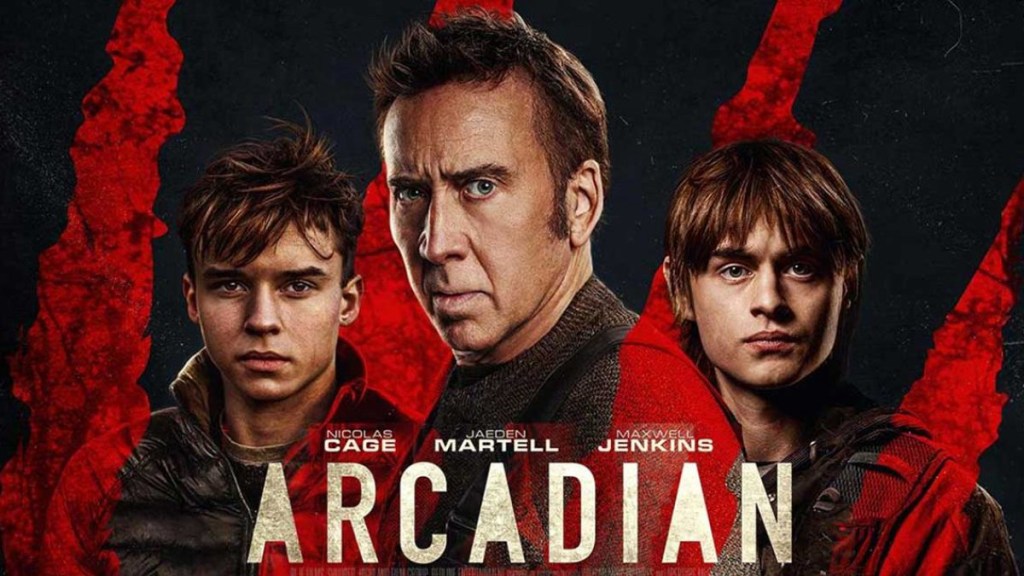
Sometimes the best apocalypse movies are not the ones trying to explain every little detail. Not every monster needs a ten minute speech. Not every world-ending event needs a scientist pointing at a screen while dramatic music plays. Sometimes it is enough to throw you into a broken world, hand you a father, his two sons, and a house that barely keeps the dark out, and let the fear do the rest. Arcadian is one of those movies. It is not about rebuilding society or finding a cure or saving the world. It is about surviving one more night in a place where the sun goes down and something awful starts scratching at the walls.
The movie opens during the collapse itself. Paul is running through pure chaos, scavenging supplies while the world seems to be ending all around him. Sirens, explosions, screaming, people panicking, everything falling apart at once. And in the middle of all that madness, all he really cares about is protecting his two infant sons. That opening does a great job telling you exactly what kind of story this is going to be. This is not about governments or politics or giant explanations. This is about a man trying to keep his children alive while the world burns down around them.
Then the movie jumps fifteen years ahead. Civilization is basically gone. Society has rotted away. Most people are dead, and what is left of humanity has been reduced to scattered farms and fragile little routines built around one simple rule: do not be caught outside after dark. Paul now lives in this run-down farmhouse with his twin sons, Joseph and Thomas, and the three of them have managed to scrape together some kind of life. During the day they scavenge, fix things, grow what they can, and try to make the house a little harder to break into. At night they lock themselves in and wait for the creatures outside to try their luck.
Right away the movie sets the brothers apart. Thomas is the impulsive one, the dreamer, the kid more likely to take a stupid risk because a girl is involved. Joseph is quieter, more thoughtful, more practical, and clearly the one thinking not just about survival today but maybe how they survive better tomorrow. That difference matters because Paul is trying to prepare both of them for a world that is not going to give them many second chances. And one of the things the movie does really well is show that survival itself has become this strange, exhausting routine. Even dinner feels tense. Even silence feels tense. They hear banging at the cellar door at night, and nobody reacts like this is some shocking new event. It is just part of life now. Something is always trying to get in.
The next day, Paul sees the damage outside and realizes the house is getting weaker. The creatures are adapting, testing, digging, learning. Meanwhile Joseph shows him that he has been secretly working on fixing up an off-road buggy, which is one of those little hopeful details in the film. Joseph is trying to build something. Trying to improve their odds. Trying to make the future slightly less miserable. Paul helps him get it running, then sends both boys out to gather wood so they can reinforce the cellar door. But Thomas, being Thomas, has other priorities. He wants to go see Charlotte Rose at the neighboring farm, and that bad decision starts the whole disaster rolling downhill.
Thomas ends up staying too long, then on the way back he falls into a cave, hits his head, and gets stranded out there after dark. Joseph makes it home without him, and once Paul realizes his son is missing, he goes back out into the night to find him. That right there tells you everything about Paul but at the same time exhibits what a regular father would do for his child. He knows exactly how dangerous it is. He knows night belongs to the creatures. He goes anyway. He finds Thomas in the cave, but now they are trapped there until sunrise, and of course that is when the monsters show up. This whole sequence is probably the movie at its best because it is pure desperation. Tight spaces, darkness, these things crawling through the rocks toward them, and Paul trying to hold it together while everything closes in. He lights a flare, sets off an explosive, gets his hand mangled in the process, and barely gets them out alive.
Back at the house, Joseph has been dealing with his own nightmare. Alone for the night, he actually manages to trap one of the creatures because instead of just panicking, he wants to understand it. Again, that tells you who Joseph is. Thomas runs on emotion. Joseph runs on curiosity and planning. He uses himself as bait, traps one of these nightmare things, and starts trying to study it. It is a risky move, but it also feels like the first real sign that somebody in this world might actually be thinking beyond “barricade door and pray.” When morning comes, Joseph finds Paul and Thomas, gets them home in the buggy, and it is obvious Paul is in bad shape.
Thomas insists they need to go to the Rose farm because Paul will die without medicine, and this is where the movie starts tightening the screws even harder. The Rose family has more supplies and better shelter, but they are not exactly eager to share. They are kind of the classic survivalist family where the circle closes tight once resources get scarce. They will help a little, but not enough. They say Paul is basically on his own. They are willing to let Thomas stay, though, which immediately causes tension between the brothers. Joseph wants to stick with their father. Thomas is torn between family, Charlotte, and the possibility of an easier life. So Joseph heads back home with a dying Paul, while Thomas stays behind.
From there, things spiral fast. Thomas tries to steal medicine for his father and gets caught. Meanwhile Joseph discovers the real problem at their house is even worse than they thought. The creatures are not just attacking doors anymore. They are tunneling underneath the floor. They are literally burrowing their way in. That detail is so creepy because it takes away even the illusion of safety. It is not just that the walls may not hold. It is that the ground itself is giving up on you. And sure enough, the same thing starts happening at the Rose farm. The creatures come up from below, tear through the place, and the whole farm turns into a slaughterhouse.
Thomas and Charlotte barely escape and make it back to Paul’s farm, which at this point is basically one last stand waiting to happen. Paul wakes up long enough to help them come up with a plan, and it is one of those grim apocalypse movie moments where everybody knows what this is building toward. Joseph starts rigging a trap using gallons of fuel as a makeshift bomb, hoping they can torch the creatures and buy themselves a chance to run.
But there is a moment I want to highlight before Paul sacrifices himself to give his children more time. It’s brief. And if you blink you’ll miss it. Hw looks over at his sons and realizes he’s done his job as a father. He’s prepared them for the new world. He sees the working together and knows they’ll be fine. And then right after he sees that he walks out into the hallway to meet his fate in an explosion that rips the house apart.
That ending works because the movie never tries to dress it up as some big heroic speech moment. It is just a father doing what he has been doing since the opening scene. Buying his boys one more chance to live. One more day. One more morning. And by the next day, when Charlotte buries her parents and joins Joseph and Thomas on the road, the movie ends on this quiet note of battered hope. The world is still ruined. The monsters are still out there. Nothing is fixed. But these kids are moving forward anyway, checking other farms, looking for survivors, carrying on because that is all they can do.
So really, Arcadian is not just a monster movie. It is a stripped-down survival story about family, instinct, and the terrible little bargains people make just to see another sunrise. It keeps the scope small, which actually makes it hit harder. No grand saving-the-world mission. No cure. No chosen one nonsense. Just a father, two sons, and the awful realization that in this world, night always comes back.

